Gold Reserves vs. Treasuries: Understanding the 2025 Milestone
Disclosure: This blog post was created with AI assistance. AI can be helpful, but it can make mistakes.
Key takeaways
- In 2025, global official gold reserves surpassed foreign official U.S. Treasury holdings, a milestone the Fed itself acknowledged.
- Central banks bought roughly 1,000 tonnes of gold annually over the past four years, double the prior decade’s pace, per the World Gold Council.
- Gold prices swung between roughly $4,283 and $4,511 per ounce in the first week of September 2026 as rate-hike expectations shifted daily.
In this article
- What Actually Happened: Gold Reserves Surpass Treasuries in 2025
- The Backdrop: A Volatile Week for Gold Prices
- Why the Fed Is Watching Inflation and Rates So Closely
- A Useful Analogy: Reserves as a Country’s Long-Term Savings Account
- What This Could Mean for Physical Gold and Silver Buyers
- Myth vs. Fact: Does This Mean the Dollar Is Being Replaced?
- Frequently Asked Questions
- A Practical Takeaway
- Sources
Gold reserves drew renewed attention after Kitco News reported on September 4, 2026, that their global official value exceeded foreign official U.S. Treasury holdings during 2025. This is a comparison of reserve values. Higher gold prices helped lift those values, so the milestone alone does not show that central banks bought more gold or preferred it to every other reserve asset.
What Actually Happened: Gold Reserves Surpass Treasuries in 2025
Per Kitco’s reporting, the value of global official gold reserves surpassed foreign official holdings of U.S. Treasury securities at some point during 2025. The Fed’s note reportedly attempted to downplay the significance, arguing the shift was driven mainly by higher gold prices rather than a dramatic jump in central bank buying, and noting that legacy holdings from the Bretton Woods era inflate the gold figures.
Even after removing U.S. holdings from the comparison, the Fed acknowledged that sovereign gold reserves were worth roughly $4 trillion at the end of 2025, slightly ahead of the $3.9 trillion in Treasuries held by foreign official institutions, according to the same Kitco account. That is a reserves-versus-reserves comparison, not a claim about gold’s spot price setting any kind of record.
What strengthens the story is the buying pattern behind it. Kitco cites the World Gold Council’s 2026 Central Bank Gold Reserves Survey, which found central banks purchased an average of roughly 1,000 tonnes of gold annually over the past four years, double the pace of the previous decade. A large share of surveyed institutions also said they expect to add to gold reserves over the next year, and most expect global central bank gold holdings to keep rising. These are survey responses reflecting institutional sentiment, not guarantees of future action.
The Backdrop: A Volatile Week for Gold Prices
While the reserves milestone reflects a longer-term trend through 2025, gold’s day-to-day price action in early September 2026 has been anything but calm. According to Kitco’s Weekly Gold Survey, spot gold opened the week near $4,439 per ounce, fell to a weekly low of $4,282.61 amid elevated Treasury yields and inflation concerns, then rebounded to a weekly high of $4,511.08 after softer labor data and less hawkish Fed commentary. A stronger-than-expected August payrolls report reversed much of that rally, and gold was last seen trading near $4,432 per ounce Friday afternoon, according to the same report.
Analysts quoted in that survey were split. Some pointed to weakening technical momentum and flagged risk of a drop toward the $4,200 area, while others argued that rising government debt continues to support gold’s longer-term path. The survey captures opinions at a particular moment. Those opinions can change after new economic data, and they are not a reliable promise of where prices will settle.
Why the Fed Is Watching Inflation and Rates So Closely
The rate debate matters because it directly affects gold’s opportunity cost. Fed Governor Michael Barr said on September 1, 2026, that he would support a rate hike if inflation doesn’t show convincing signs of moving back toward the Fed’s 2% target, according to CNBC’s report. Barr noted inflation had remained above target for roughly five and a half years, with headline prices up 3.7% year-over-year at the time of his remarks. Markets were pricing in roughly a two-thirds chance of a rate increase at the Fed’s mid-September meeting, per the same report.
A Useful Analogy: Reserves as a Country’s Long-Term Savings Account
Think of a central bank’s reserves like a household’s long-term savings account, separate from the checking account it uses for daily bills. Treasuries function like a high-yield savings account: liquid, income-generating, and useful for near-term needs. Gold functions more like a paid-off house or a vault of family heirlooms: it does not pay interest, but it does not depend on another party’s promise to pay either. When a growing share of households shift savings toward the vault rather than the interest-bearing account, it does not mean the bank collapsed. It means priorities changed, often due to concerns about currency stability, inflation, or counterparty risk.
What This Could Mean for Physical Gold and Silver Buyers
For physical gold and silver buyers watching this story, a few practical points stand out:
- Central bank buying reflects strategic, long-term positioning, not the day-to-day swings retail buyers experience; the two operate on different timelines.
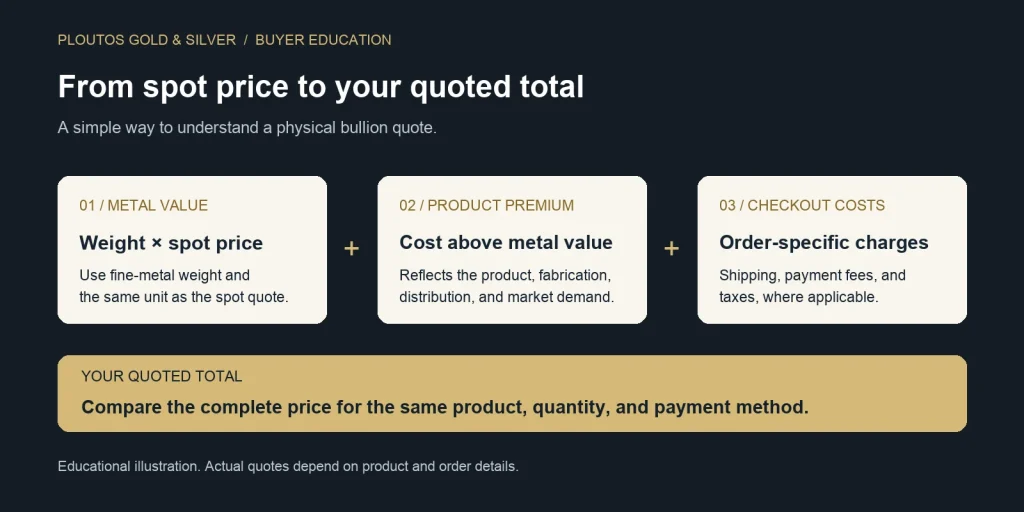
- The roughly $230 weekly trading range reported by Kitco shows why a headline price is not a fixed purchase quote. Compare the same metal weight, product premium, and total delivered cost.
- Tracking spot price charts regularly can help buyers understand normal volatility versus unusual moves.
- Diversifying between gold bullion products and silver bullion products is one way some buyers balance exposure across metals with different industrial and monetary roles.
Myth vs. Fact: Does This Mean the Dollar Is Being Replaced?
Myth: Gold overtaking Treasuries in central bank reserves means the U.S. dollar is losing its reserve-currency status. Fact: Kitco’s reporting explicitly states this milestone does not mean the dollar’s dominant reserve status is ending, nor that Treasuries have become irrelevant; they remain among the world’s deepest and most liquid financial assets. The more accurate takeaway is that central banks increasingly treat gold as a strategic complement to, and in some cases partial substitute for, traditional dollar reserves.
Frequently Asked Questions
Does this milestone mean gold hit a new all-time high price?
No. The milestone concerns the total value of global gold reserves versus foreign-held Treasuries, not a spot-price record. Gold’s price during the reported week ranged between roughly $4,283 and $4,511 per ounce, according to Kitco’s survey.
What does the World Gold Council survey show?
The World Gold Council’s 2026 survey found central banks have purchased about 1,000 tonnes annually over the past four years, roughly double the prior decade’s pace, though the survey does not specify every institution’s individual motivation.
How does the Fed’s interest rate decision affect gold prices?
Higher interest rates generally increase the opportunity cost of holding non-yielding assets like gold, while rate cuts tend to reduce it; this is part of why traders reacted sharply to labor data and Fed commentary during the reported week.
A Practical Takeaway
This reserves milestone is a slow-moving structural story, not a signal to time any single purchase. Buyers building physical positions, whether in coins like the 2026 1 oz American Silver Eagle and 1 oz American Gold Buffalo, or larger holdings such as a 100 oz silver bar from LBMA-recognized brands, may find more value in understanding the underlying trend than reacting to any single week’s price swing. Staying informed through verified reporting remains the most useful approach.
For scheduled purchases, explore Ploutos Steady Stack for current eligible products and program details. Each order uses the price when it executes; enrolling does not lock a future price.
Sources
Disclaimer: This blog post was created with AI assistance. AI can be a useful tool, but it can make mistakes. The content is for entertainment purposes only and is not financial, tax, or legal advice. Please call Ploutos Gold & Silver at 617-564-1630 if you have any questions.
Appointment required
Local pickup and bullion testing are by appointment only
Planning to pick up an order or ask about bullion testing in Brockton? Text or email first so we can arrange an appointment.